
CRM and AI automation for the concert agency Northern Sound
Ticket sales from three platforms, budgets and concert closeouts in one system, plus a Telegram assistant for management.

The task
Dozens of concerts a month, all of it in spreadsheets
Northern Sound is a concert agency with about seven departments, working in several cities. Everything lived in Google Sheets: a yearly sheet with hundreds of columns, a sheet per tour, dozens of budget files. A concert had no ID, only date, artist and city typed as free text.
- Every day the ticketing team copied sales from several ticketing accounts into the sheet by hand.
- The same seats sell through two platforms, and adding the accounts up overstated sales.
- Quotas lived inside formulas, easy to overwrite or count twice.
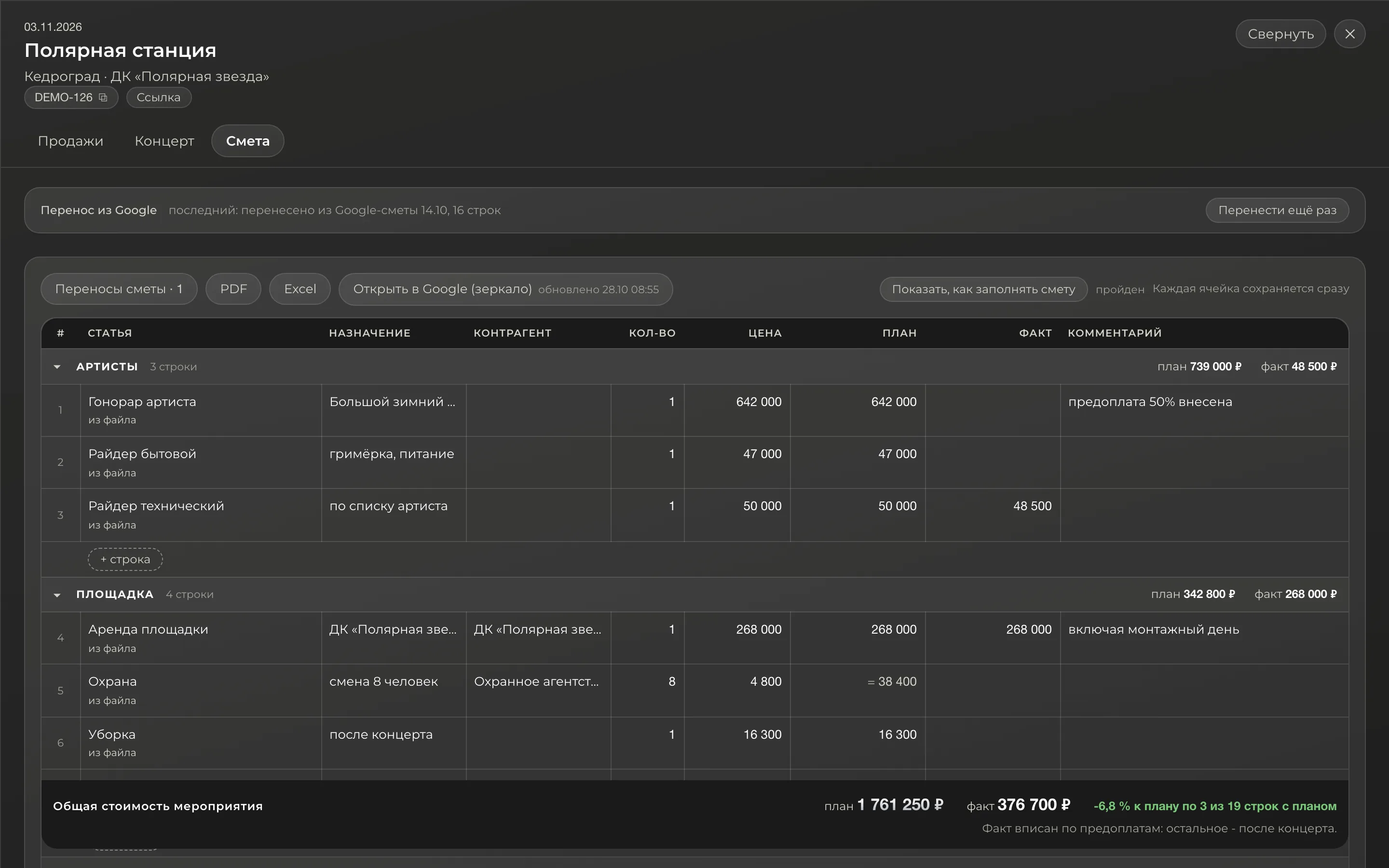
- Every tour manager named budget lines their own way; most budgets we reviewed had broken totals.
- Closeouts and 1C entry were manual. Discrepancies surfaced late, sometimes after the show.
What we built
One system instead of dozens of files
The sheets stay as a familiar view. The truth lives in the CRM database; code keeps the agency’s live files safe from writes.
Sources
- TicketsCloud
- Yandex Tickets
- Third ticketing system
- Google Sheets
- 1C
- Meeting notes
Core
- Event registry
- ID, links, history
- Checks on every run
What people see
- CRM screens
- Analytics
- Telegram assistant
- Reminders
Roles
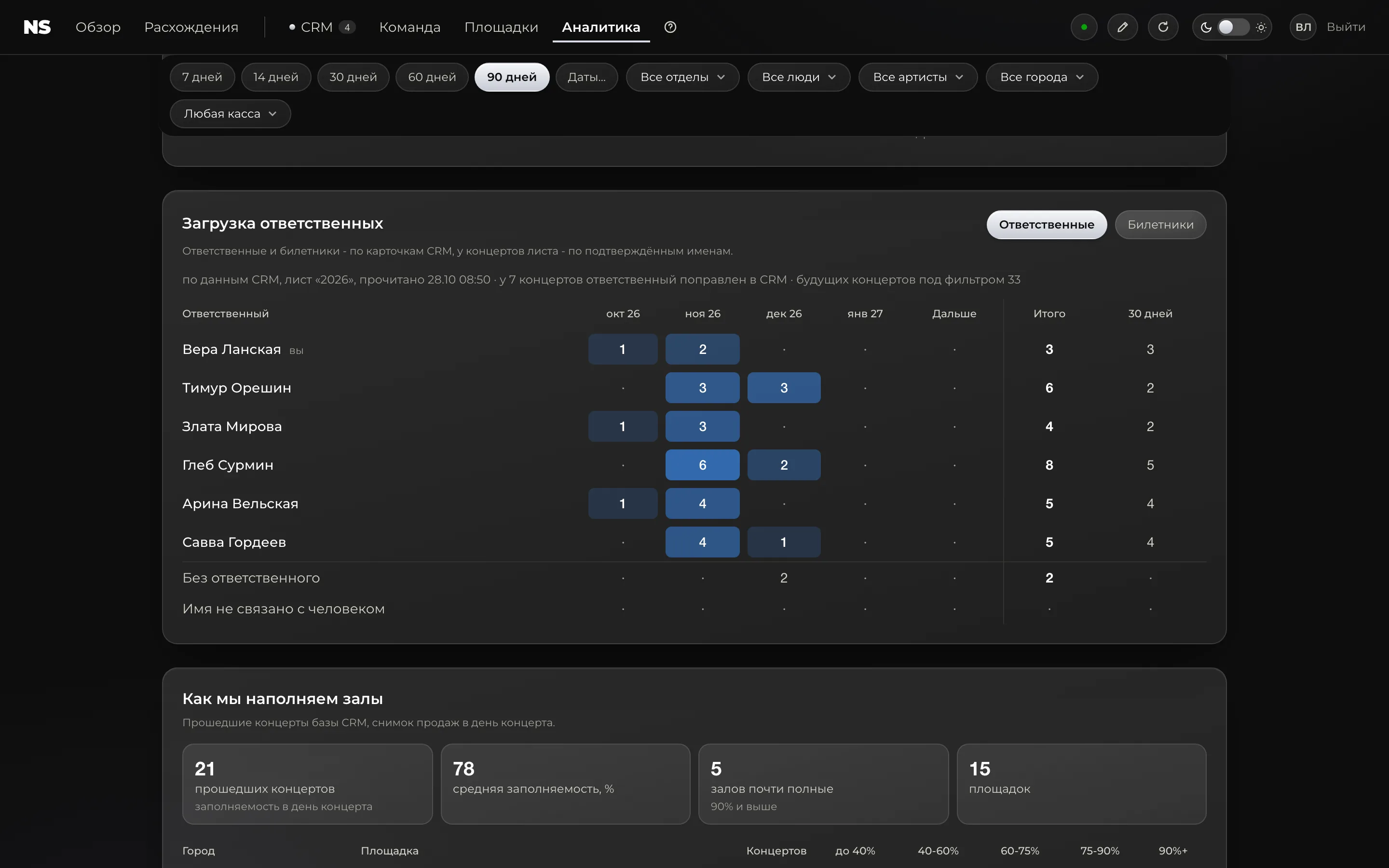
- Management
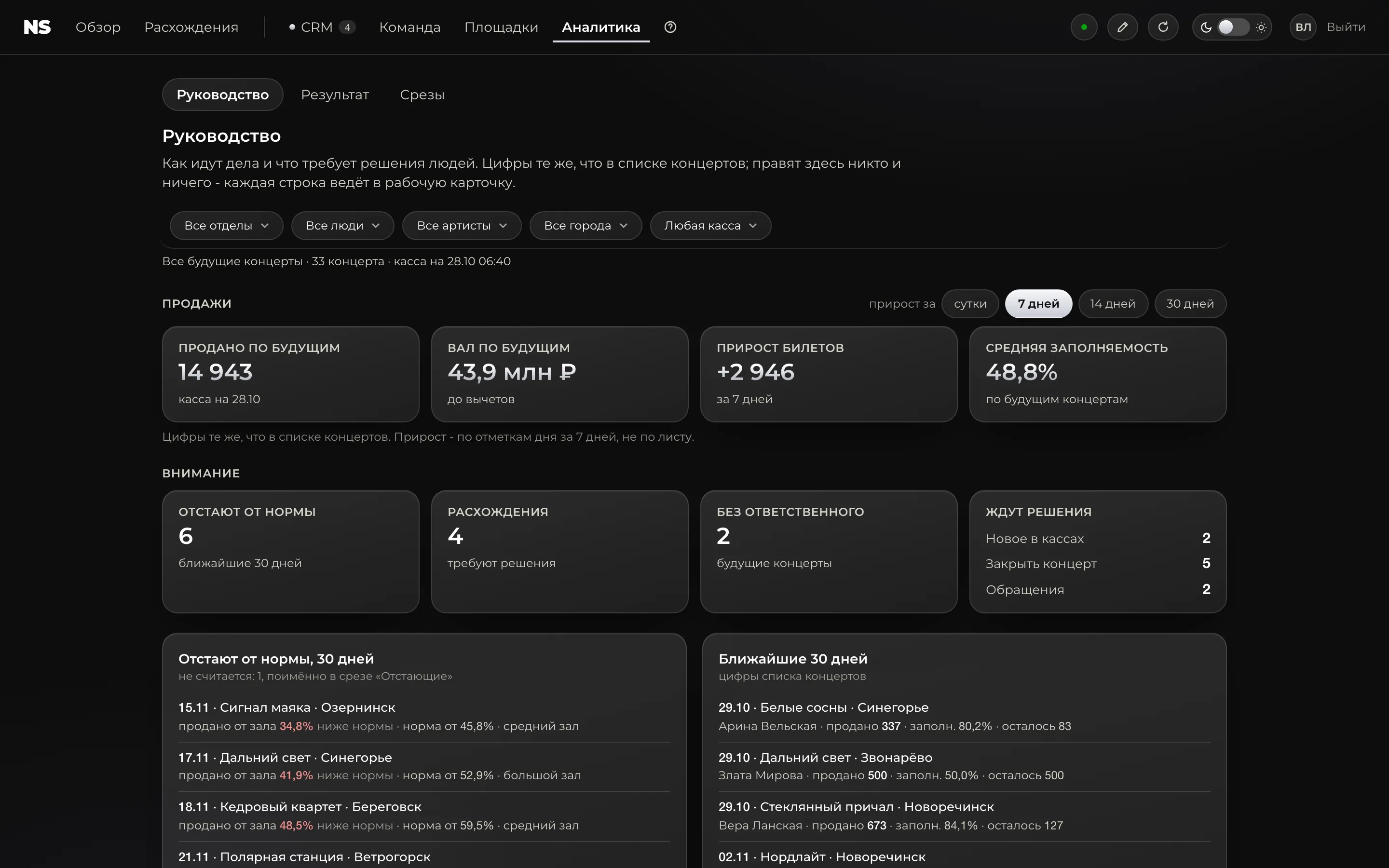
- Sales for upcoming shows, what is behind, what waits for a decision.
- Tour managers
- Their concerts, budgets, cost recovery.
- Ticketing team
- Quotas, manual sales, date moves, new events on sale.
- Finance
- Number checks, concert closeout, the 1C export.
- Admin
- Accounts, roles, directories.
Stages, about four months
- 1
Audit and map
Rule one: never write to the live sheets.
- 2
Sales collection
Three ticketing systems into one sheet.
- 3
Budget closeout
Ticket actuals from orders, formulas fixed.
- 4
Read-only CRM
Permanent IDs, discrepancies, one sales figure.
- 5
CRM for entry
Concerts, budgets and quotas entered in the CRM.
- 6
Rollout
Every department on the CRM, the assistant in Telegram.
- 7
Tuning
Concert economics, closeout by finance, 1C reconciliation.
- 8
Switchover day
Next: the CRM becomes the source, the sheet read-only.
How it works for the team
Every role starts on its own screen
-
My day
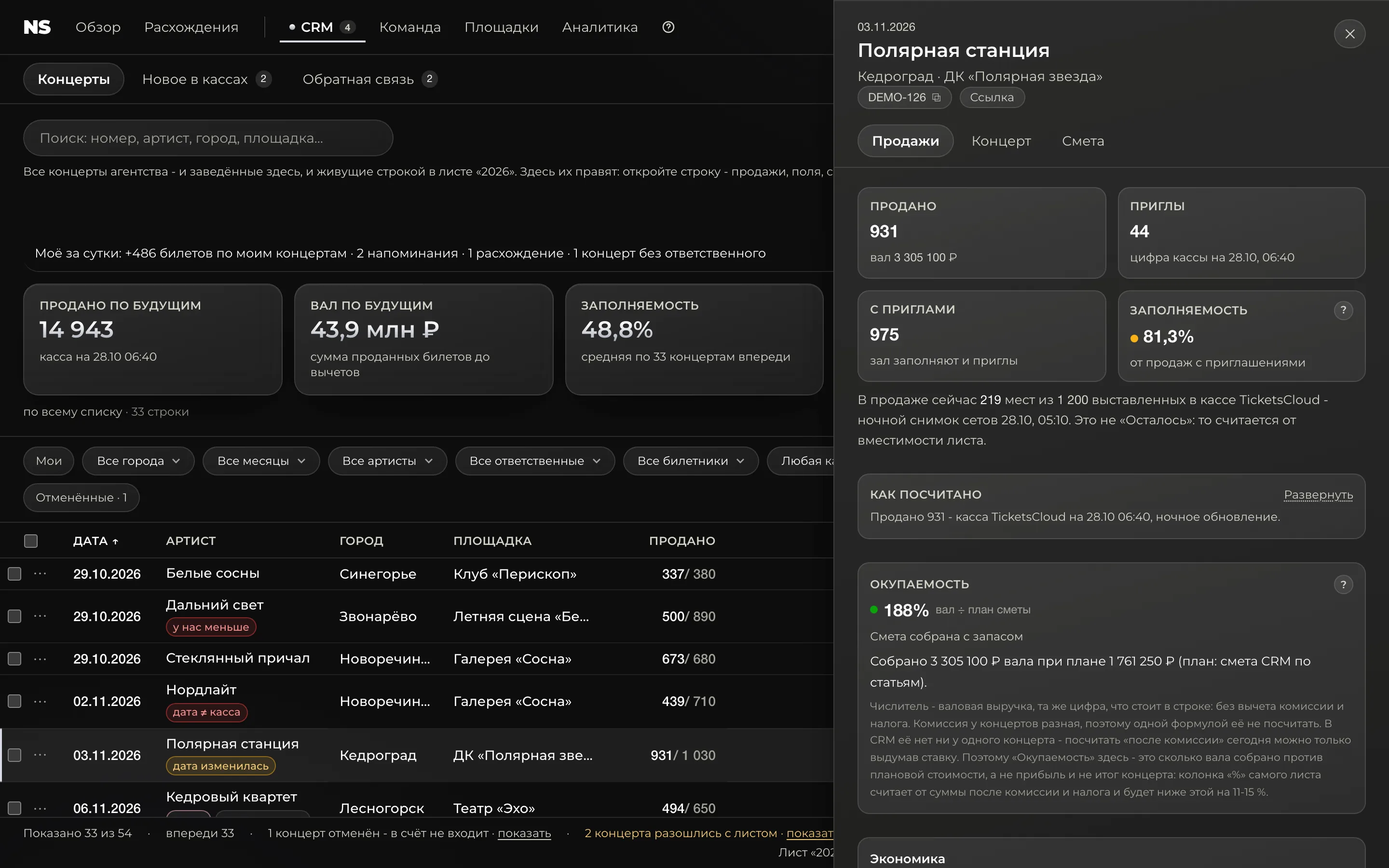
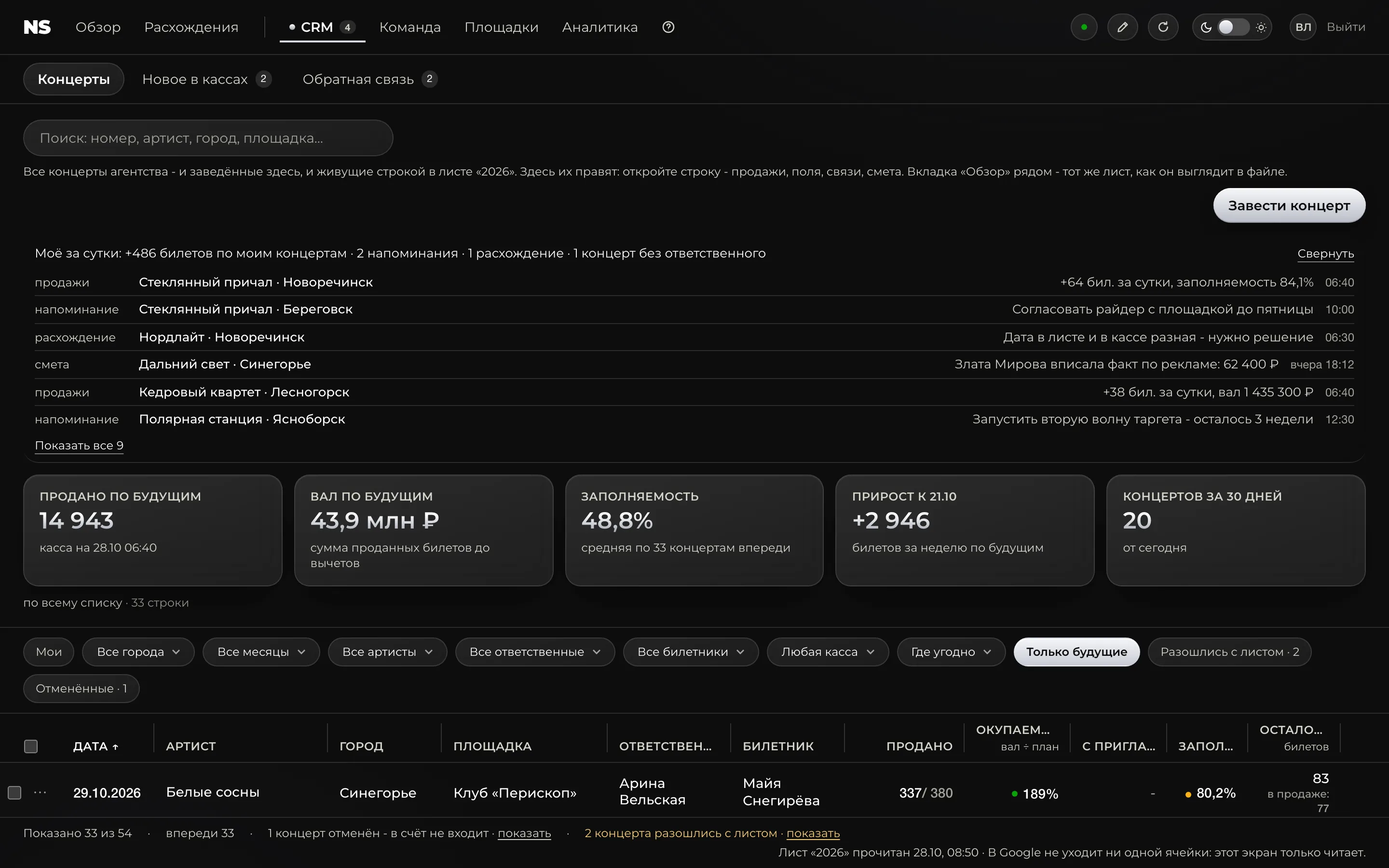
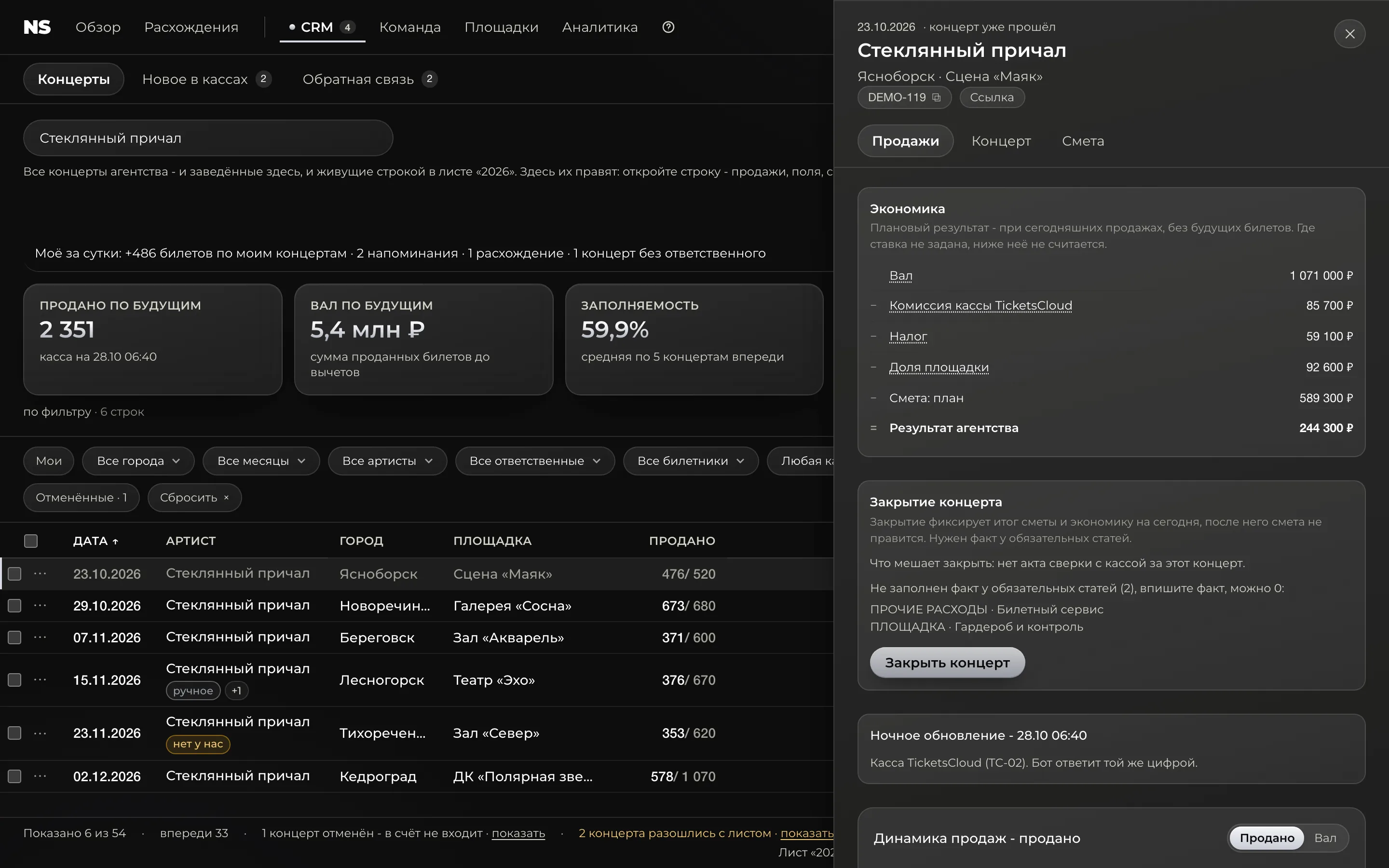
What happened to my concerts in 24 hours and what waits for me.
-
Discrepancies
Checked on every run. A flag says what is wrong and what to do.
-
New events
On sale but not in the registry? A Telegram card asks whether to add it.
-
Reminders
A personal Telegram message in hours the person picked.


AI assistant
Ask in Telegram, get the number from the screen
- Runs on Claude with tools and says only what the analytics screen shows.
- Code checks every number. If it is not in the tool output, the answer does not go out.
- Names the source and the level of trust. Money fields never reach the model.
CRM assistant
bot · demo data
What’s on fire this week?
6 concerts in the next 7 days. Two are behind the sales norm for this point:
• Polar Station, Cedargrad, Saturday: 412 of 900 seats sold
• White Pines, Clearwood, Sunday: 188 of 600
Source: analytics screen. Compared with our own history, not a forecast.
Effect · Estimate
Roughly one full-time role of manual work
- 30-55 h of manual work a week, estimated
- ≈ 1 full-time role
EstimateAn estimated 30 to 55 hours of manual work a week, roughly one full-time role, across ticketing, tour managers and accounting. Counted by CATS from the audit: how often each process runs and how long it takes by hand. No time tracking; the estimate is for work after the switchover.
- One sales figure everywhere, with a rule against double counting between platforms.
- A concert on sale without a row shows up within three hours, not at closeout.
- Faster closeouts: actuals come from ticketing, the 1C export sits next to the budget.
For your business
We build systems like this for your business
For companies where numbers live in sheets and chats and people spend days chasing them.
- 01
Process audit
Talks with departments, real sheets and chats, what to automate first.
- 02
First automation
One painful process, on a test copy.
- 03
CRM
Your registry, screens for each role, analytics.
- 04
Assistant
In Telegram, answering with your numbers.
- 05
Support
A watchdog, backups, changes.