How it works
Brief in, released work out. People decide in between.
CATS OS takes the brief, the team, the calendar and the AI models as inputs, coordinates the work between them and tracks it until it ships. Each module below carries its status: what runs today, what we are building, and what is still vision.
- Live8 modules
- Building3 modules
- Vision6 modules
Inputs
- Brief What, for whom, by when
- Team People, roles, chats
- Calendar Premieres, deadlines, posts
- AI models Interchangeable suppliers
- Plain-message understanding
- Approval queue
- Deadline reminders with quiet rules
- Responsibility map
- Close by fact
- Publishing by content plan
- Memory of people and projects
- Project cabinet
- Account manager for client chats
- Client memory
- Response SLA
- Brand Brain
- Model Router
- Creative QA
- Versioning and localization
- Rights and provenance
- Performance loop
Outputs
- Episodes Released on schedule
- Campaigns Delivered to the client
- Publications Posted by the plan
Feedback: results back into the system
LiveToday: daily YouTube metrics and a weekly growth report for MONO.
VisionNext: results from every platform shape the next brief.
Modules
17 modules, three statuses.
In code and running on our productions
Built and used every day on the MONO season and in the cabinet.
- Plain-message understanding Reads team replies without commands: done, not done, moved, blocked, question, ok.
- Approval queue Anything new or external waits as a card: Send, No, edit by reply, later. More than three an hour arrive as one numbered list.
- Deadline reminders with quiet rules Four-step ladder. Silent 22:00 to 09:00 and on weekends, two tags per person a day at most.
- Responsibility map Task type, then role, then person. A rule picks who gets tagged, not the model.
- Close by fact A task closes when the file is on Drive, the box is ticked or the video is live.
- Publishing by content plan Posts go out on schedule, with a card to the producer 30 to 60 minutes before.
- Memory of people and projects Last five exchanges per person, response times, active hours, the current state of every episode.
- Project cabinet Registry of projects, Google sign-in, owner and member roles, screens per project.
Designed, being built
The account manager for client work: one bot and one core for every studio project.
- Account manager for client chats Reads the client chat and drafts replies. Nothing leaves without the producer pressing Send, checked in code.
- Client memory History, agreements and a profile for every client and contact.
- Response SLA Tracks who owes the client an answer: a card at 12 hours, on top at 20, logged at 24.
Where it goes
From the long-term plan. No code yet.
- Brand Brain Brand rules, products, references, approved and rejected work as one source any agent can ask.
- Model Router Picks a model per shot by quality, cost, speed and brand rules.
- Creative QA Checks logo, product shape, colours, artifacts and continuity before a person looks.
- Versioning and localization One master, many markets, formats and platforms, managed as a system, not as folders.
- Rights and provenance Source, model, references, rights and approval history for every asset.
- Performance loop Results from platforms flow back into the next brief.
Old way, new way
Fewer handovers between the brief and the result.
How production runs now
Every arrow is a handover, a chat or a file sent by hand.
- Brief
- Agency
- Production company
- Many tools
- Files
- Drive
- Client comments
- Revisions
- Localization
- More files
How it runs on CATS OS
Solid steps run today. Dashed steps are vision.
- Brief
- CATS OS
- Orchestration
- Production
- QA
- Approval
- Versioning
- Delivery
- Learning
- Orchestration: responsibility map, reminders.
- Production: people and AI tools.
- Delivery: publishing by plan, close by fact.
- Learning: tone from producer decisions; creative performance is Vision.
- QA, Versioning: Vision.
People and AI
AI handles scale. Humans handle judgment.
The system
- Reads every message in the team chat
- Drafts reminders, posts, press texts and replies
- Tracks deadlines and watches folders for files
- Keeps memory of people, projects and decisions
- Learns the producer’s tone from what they send and reject
Next: routing shots between models, QA, versioning and localization (Vision).
People
- Taste and creative direction
- Strategy and brand judgment
- Who does what
- Send or No on every external text
- Final approval
Nothing leaves the team without a person pressing Send.
The cabinet
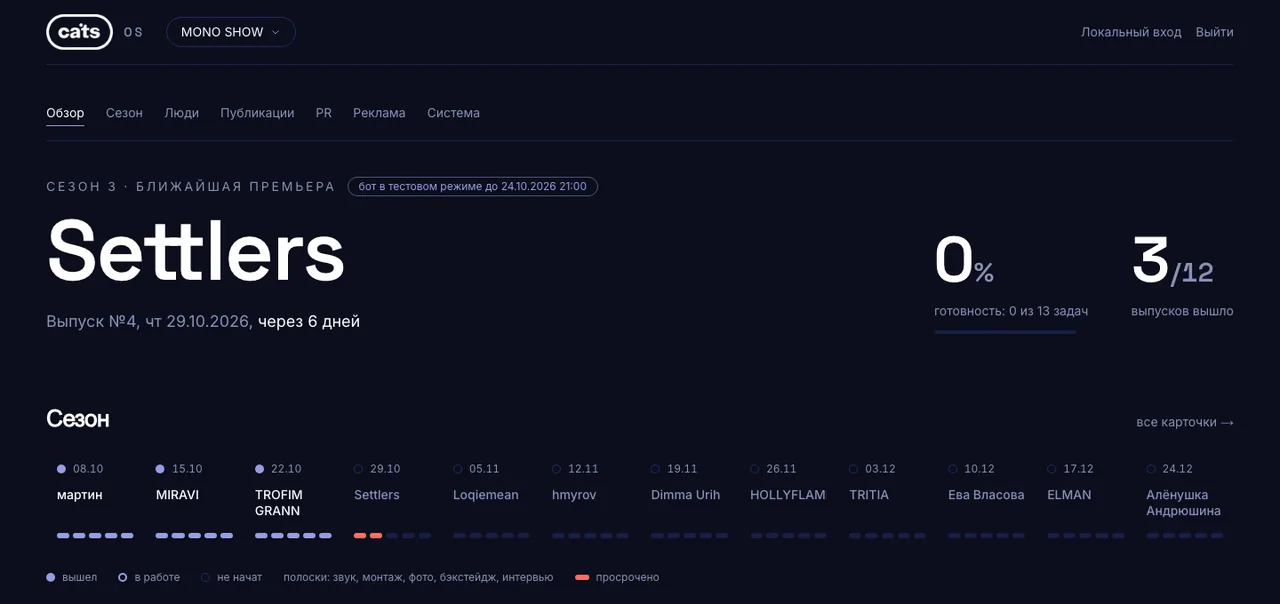
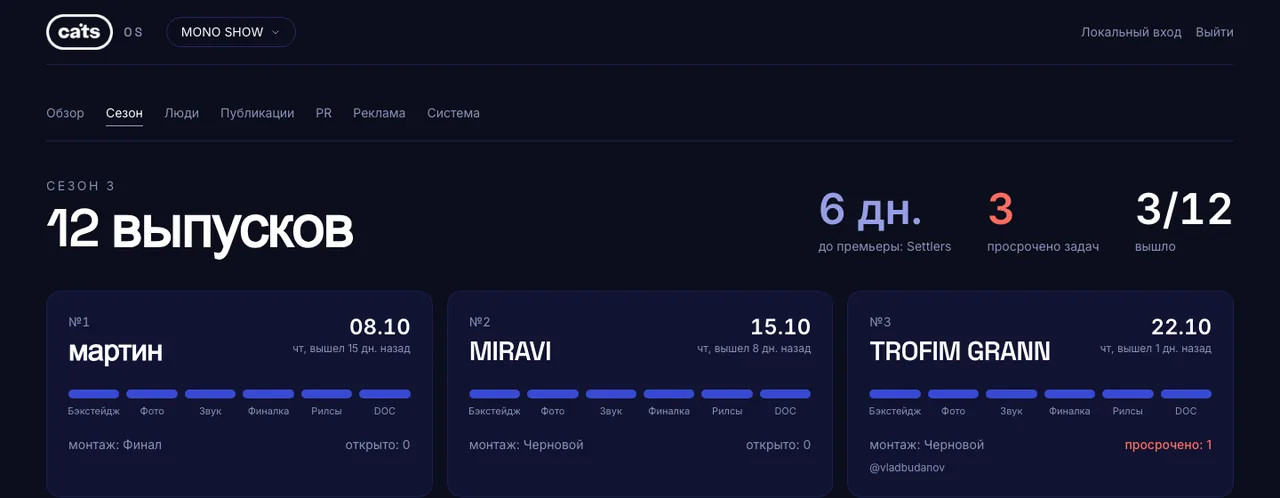
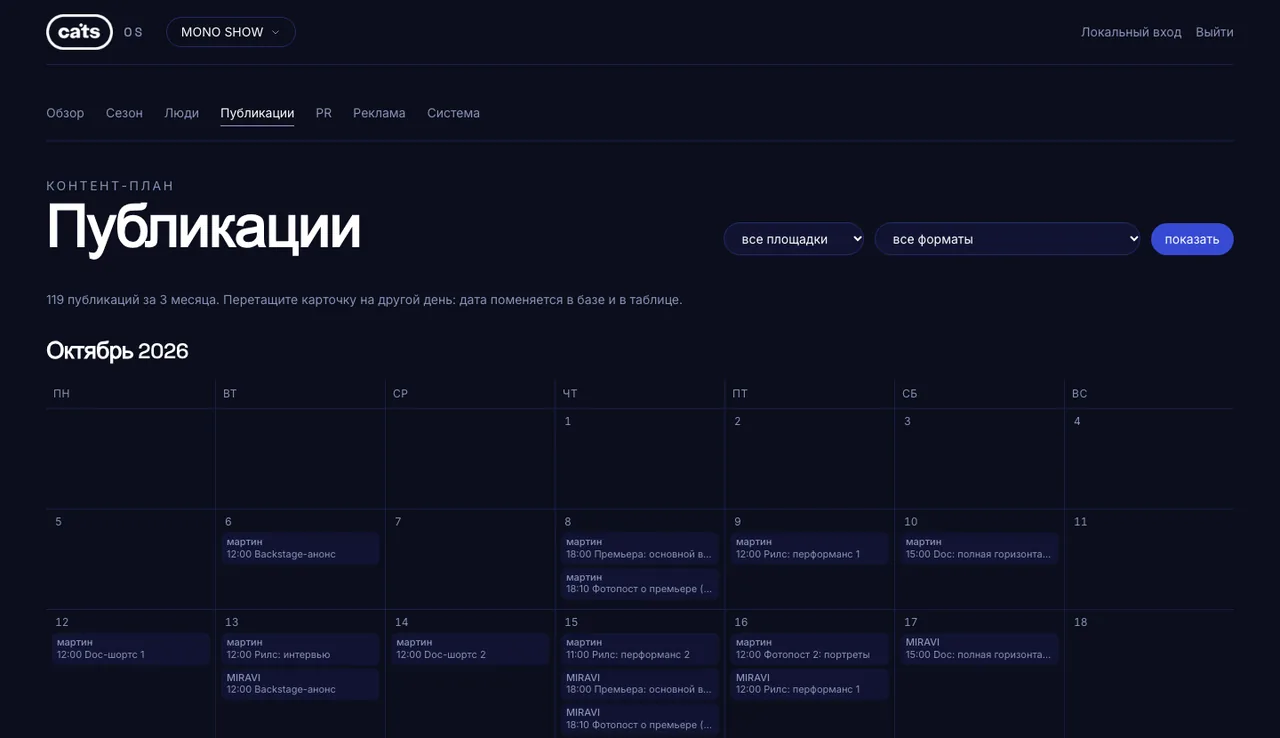
DemoThree screens from the cabinet.
Real screens of the CATS OS cabinet for the MONO season, running locally on demo data: the same season layout, with dates and progress filled in for the demo. The interface is in Russian, the language of the crew.